
I know that rack-and-pinion steering seems an esoteric and niche topic. But Brad Keselowski doesn’t think so. After his crash at Michigan, Christopher Bell might not, either.
Safety motivates much of the NASCAR race car’s evolution. But manufacturers support NASCAR because they want to sell cars. Most performance car buyers don’t buy only on looks. They’re performance cars. They have to perform. Rack-and-pinion steering is the clear preference if you want precise handling. But there’s a potential downside, too.
What is a Rack? What is a Pinion?
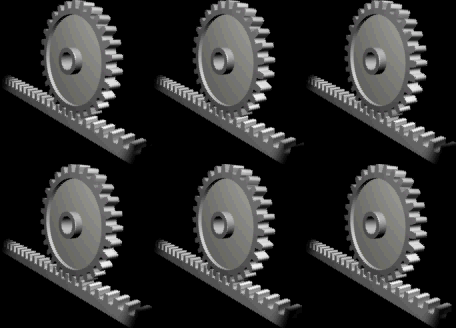
GIF from OSHA Directorate of Technical Support and Emergency Management, Public domain, via Wikimedia Commons
You likely learned about gears as part of a simple machines unit in elementary or middle school. That means you know that gears always work in pairs (or triples, or even more exotic combinations.) Also, that they provide mechanical advantage: With the right set of gears, you can crank once and turn something else around twice.
A rack-and-pinion gear set translates rotary motion to linear motion, as I show at left. The top gear is the pinion and the bottom is the rack.
Now imagine a steering wheel connected to the pinion gear and the ends of the rack connected to a car’s wheels on either end. When the rack moves, it pulls the wheels left or right. Voila: Turning accomplished.
Unless you have a very exotic car, your car probably uses rack-and-pinion steering. So does the Gen-7 race car.
Before Rack-and-Pinion Steering: Recirculating-Ball Steering
Gen-6 (and prior) cars used a traditional recirculating-ball steering gearbox with a sector shaft. This system was used in all early cars, although some luxury manufacturers continued using them well into the 1990s. They’re still used in specialty applications like true off-road vehicles and heavy-duty trucks.
The diagram at right shows how recirculating-ball steering system works. The link from steering wheel to car wheel goes like this:
Steering Wheel → Steering Shaft → U-joints → Recirculating-ball steering box → Sector shaft → Pitman arm → Center (or drag) link → Toe Links → Steering arms on the front wheels
The key here is the steering box, which converts the rotation of the steering wheel into the motion of an arm called the sector. The sector shaft moves like a windshield wiper, but slowly and over less of an angle.
When the sector shaft moves, it moves the Pitman arm and the center link. The center link pushes on one toe link and pulls on the other. The car turns.
If you look this up in a car manual, you will see ‘tie rod’ rather than toe link. I’m told this is one of those European/American differences.

As with virtually anything, the recirculating ball steering system had strengths and drawbacks.
Positives
- The system is extremely robust, which means it can handle heavy impacts.
- You can achieve a wide range of steering ratios, which determines how much you have to turn the steering wheel to turn the car wheels.
- This system is good for heavy front axles — which is why heavy-duty trucks still use it.
- It’s easy to change the steering ratio: Simply switch out the steering box. No need to mess with any of the linkages.
- It was state-of-the-art when stock cars were first created. We stick with what we know, right?
Negatives
- Can be more expensive that other types of steering systems
- The steering box relies on a collection of stainless steel bearings — which means friction
- A lot of play/backlash, which means that the steering wheel doesn’t always go back to where it was. The problem gets worse with wear.
- Requires regular maintenance, including checking for wear, lubrication, and the tightness of linkages.
Rack and Pinion Steering System
Rack-and-pinion gears were used early on in anything that required precise linear motion: lathes, for example. British sports cars in the 1950s standardized rack-and-pinion steering for production cars. Precision is one of the two main reasons the automotive industry moved to rack-and-pinion systems. The other is cost.
Rack-and-pinion systems started appearing in U.S. cars in the late 1970s when the fuel crisis hit and U.S. cars went on a diet. Before that, American cars were larger and heavier, and required the robustness of the recirculating-ball steering system.

This scheme provides a much more direct steering path:
Steering Wheel → Steering Shaft → U-joints → Rack-and-pinion → Toe Links → Steering arms on the front wheels
This eliminates a lot of material between the steering wheel and the car wheels relative to the recirculating ball steering box method. That’s a good thing, but also and a bad thing.
For the specialists, note that the pinion gear for most rack-and-pinion systems is helical.
Positives
- This system is much lighter than a recirculating ball steering box. There’s less weight to bog down the car
- Low friction — just the mesh of the gears.
- Much less backlash, so its more precise.
- Simpler and less expensive
- More sensitive for the driver.
Negatives
- Cannot deal with high loads (i.e. heavy front axles.)
- Low tolerance to shock load: Big bumps and jolts can cause real problems — which we’ve seen already.
- Providing a more direct path from steering wheel to car tire improves sensitivity, but also more readily transmits force from the tires to the steering wheel.
A Direct Comparison
This is just the two pictures in one place, but I hope it shows you how different the two systems are.

Christopher Bell’s Crash
Christopher Bell had to turn over his car to Brent Crews at San Diego because his broken wrist made it very difficult for him to drive a road course. Bell’s crash and subsequent injuries are one of the more severe instances we’ve seen in the Gen-7 car.
Brad Keselowski believes that the rack-and-pinion steering rack is reponsible for Bell’s injury.
“A steering box with a center link, Pitman arm, toe link, had a lot of crush shell naturally built into it,” Keselowski said at Pocono Raceway. “So, with the old car, even though it’s a very antiquated system, it actually served the sport very well. You could have a lot of wheel-to-wheel contact and the system would absorb it without transferring it through to your arms and hands at the level that it does today with a rack and pinion.”
In his media appearance at Pocono, Denny Hamlin said that most drivers drive with one hand. He didn’t mean that they only kept one hand on the steering wheel: He meant that, as he put it “my left hand does all the work and my right hand is just along for the ride.”
I don’t know whether Bell is a ‘left-handed driver’, but I suspect so. If his left hand was “just along for the ride”, it might not be necessary to shave down his steering wheel so that he could get a good grip with his left hand.
When turning left, a left-handed driver pulls the wheel down with his left hand. Bell said at Pocono that his hand was wrist up, at the six-o’clock position on the wheel, when his car slammed against the wall. It makes sense that, when the car wheels impacted the wall, it created a big force on the steering wheel. It happened so quickly that Bell wouldn’t have had time to let go.
Rack-and-Pinion Steering is Not Inherently Unsafe
Before those of you looking for reasons to complain about the Gen-7 car start going off, let’s remember that Bell’s crash was the most severe of the Next-Gen era. Bell himself has said repeatedly that he believes the efforts of NASCAR engineers made it possible for him to walk away from that crash with nothing more than a broken wrist.
Let’s also remember that racing is inherently dangerous. Anyone who thinks a race car is a failure if it can’t keep a driver safe from any magnitude crash is unrealistic. Anyone who suggests that NASCAR is dismissive of safety simply doesn’t know the men and women who dedicate their lives to safety research and development.
There is no way to make a race car 100% safe. Keselowski points to the steering system as an area for future work, not an immediate threat to driver safety.
Remember also that this happens in street cars as well. When the wheels of a car sustain a force — from contact with another car, for example, the steering wheel can be jerked out of the drivers’ hands. Depending on where the hands are, fingers and wrists can be broken. I know of at least one case in which a driver sustained serious nerve injury in such an accident.
But these types of accidents — like Bell’s are on the extreme side. And, thankfully, rare.
Please help me publish my next book!
The Physics of NASCAR is 15 years old. One component in getting a book deal is a healthy subscriber list. I promise not to send more than two emails per month and will never sell your information to anyone.

Be the first to comment